Why One Data Scientist Isn't Enough
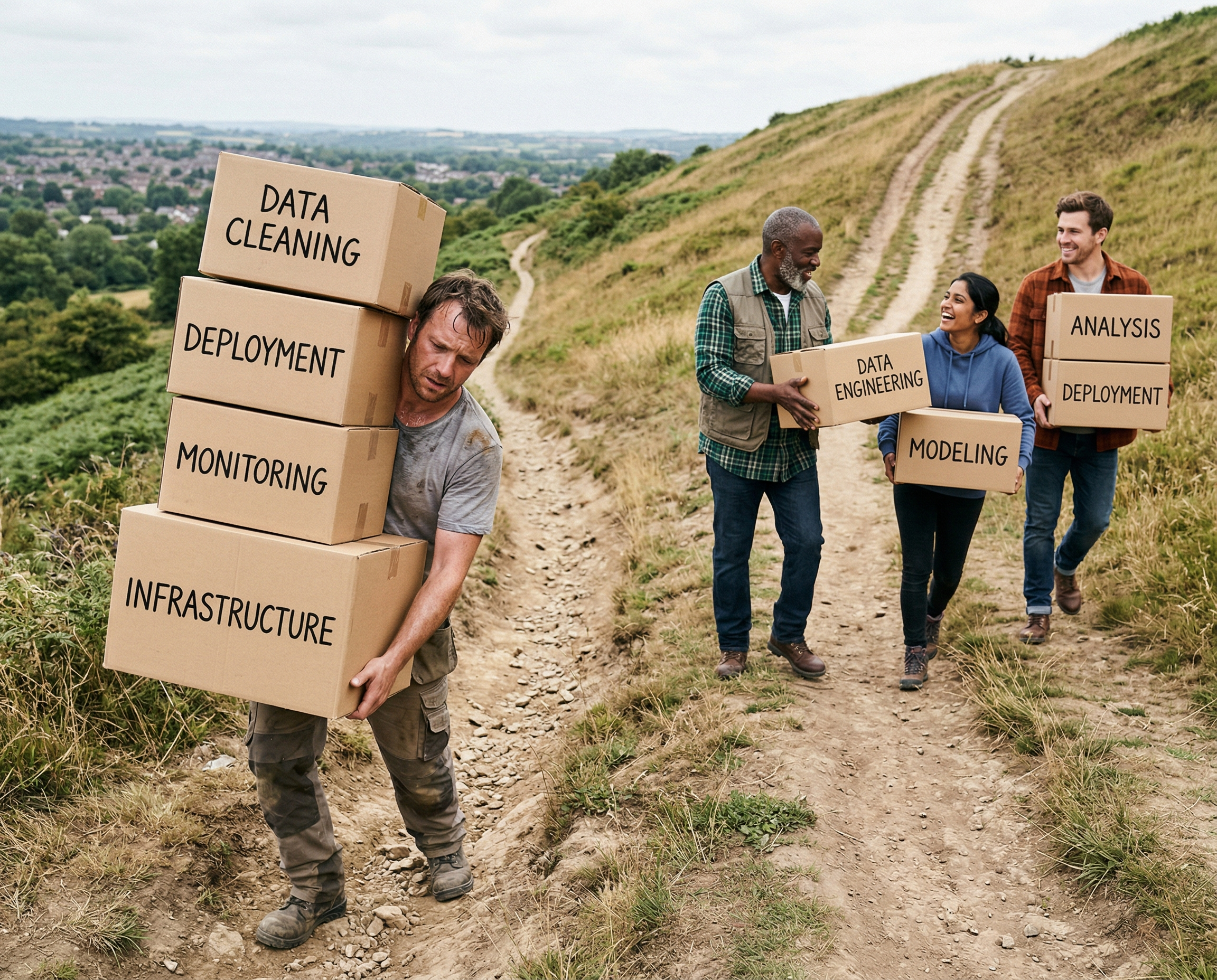
AI increasingly demands a wide array of skills to cover the ground between idea, creation, implementation, deployment and scaling / monitoring.
You made the hire.
You found someone with the right credentials, the right experience, maybe even a graduate degree in machine learning. They were supposed to be the person who finally got your AI initiatives off the ground.
Six months in, nothing is in production. Your data scientist is buried in data cleaning, wrestling with infrastructure they weren't hired to manage, and building prototypes that never make it past a Jupyter notebook. They're not failing. They're doing exactly what one person can do when you hand them a five-person job.
The Myth of the Full-Stack Data Scientist
Somewhere along the way, the industry started treating "data scientist" as a catch-all title. The job descriptions tell the story: must know Python, SQL, TensorFlow, cloud architecture, data engineering, MLOps, statistical modeling, and stakeholder communication. Oh, and experience deploying production systems at scale.
That's not a job description. That's a department.
Building AI systems that work in production requires at least three distinct skill sets that rarely live in the same person: research and modeling, data engineering, and ML operations. Asking one hire to cover all three is like hiring a single person to be your architect, general contractor, and electrician. They might know something about all three, but the house isn't going to be built well.
What Actually Happens
It plays out the same way almost every time. The data scientist spends their first few months getting access to data, understanding the business context, and cleaning datasets that were never designed for machine learning. Necessary work, but it's data engineering work — and it eats months that leadership expected would be spent building models.
When they finally get to modeling, they build something promising in a notebook. It performs well on test data. The demo looks good. But then comes the question nobody planned for: how does this get into production?
Deploying a model means building APIs, setting up monitoring, handling versioning, managing retraining pipelines, and integrating with existing systems. These are software engineering and infrastructure problems. Your data scientist may be able to figure some of it out, but they're learning on the job, solving problems that a dedicated ML engineer would handle in a fraction of the time.
Meanwhile, leadership is wondering why the AI investment hasn't produced results.
The Isolation Factor
There's something else going on that doesn't get enough attention. A single data scientist working inside a non-technical organization is professionally isolated. No one to review their modeling choices. No one to debate architecture decisions with. No one who understands why the work is taking longer than the vendor demos suggested.
That isolation pushes toward two outcomes. Either the data scientist makes decisions in a vacuum and builds something that works technically but misses the business need, or they get so cautious about making wrong choices that progress grinds down. Both paths end the same way: leadership loses confidence, the data scientist gets frustrated, and they leave within 12 to 18 months. Then the cycle starts over.
What the Role Actually Requires
The organizations that successfully build AI capabilities in-house don't start with one hire. They start with clarity about what they're building and what skills that demands.
A production AI system needs someone who understands the data and can build reliable pipelines. It needs someone who can research, experiment, and select the right modeling approach. And it needs someone who can deploy, monitor, and maintain that model once it's running. In larger organizations, add a product manager who translates between the technical team and business stakeholders.
That doesn't mean you need four people on day one. But it does mean a single data scientist, no matter how talented, will hit a ceiling unless you've planned for the capabilities they need around them.
The Alternative to Hiring Your Way Out
For mid-market organizations that aren't ready to build a full AI team, the better path is often pairing internal knowledge with external depth. Your people understand the business, the data, and the problems worth solving. An external team with production experience can bring the engineering, architecture, and deployment expertise that turns a promising prototype into a working system.
This isn't about outsourcing your AI strategy. It's about being honest that building production AI requires a combination of skills that takes years to assemble internally. The organizations that get this right stop treating AI as a single hire and start treating it as a capability that needs a team — whether that team is fully internal, partially external, or somewhere in between.
The question isn't whether your data scientist is good enough. It's whether you've set them up to succeed.